
Bookkeeping errors rarely surface at the point of entry — a miscategorized transaction or skipped reconciliation often appears later, when reports stop matching bank balances. Strong bookkeeping for small business depends more on consistent processes than complex tools. Because financial data supports decisions around cash flow, staffing, and planning, inaccurate records create unnecessary risk.
Small business owners spend an average of more than 20 hours per month on financial administration, 1 which adds up to roughly 240 hours a year. Disorganized bookkeeping takes longer to fix the further it falls behind. That extra work tends to show up during tax season, loan applications, and end-of-year reporting.
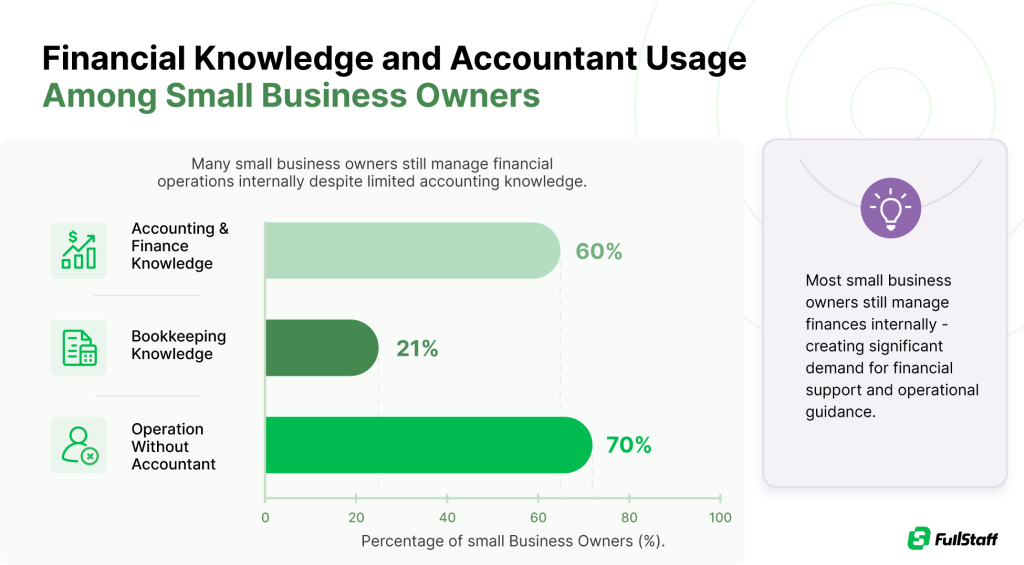

📊 60% of small business owners feel they are not knowledgeable about accounting and finance, and 21% admit they do not know enough about bookkeeping specifically — yet nearly 70% operate without a professional accountant. 2
Businesses with clean books tend to keep things simple. They follow a consistent set of habits, use reliable systems, and know when to bring in outside help. Here are the seven habits behind highly effective business bookkeeping:
What Keeps Books Clean?
Businesses with organized financials typically follow seven disciplines:
- Separate business and personal finances
- Categorize transactions weekly
- Reconcile accounts monthly
- Close the books on a fixed schedule
- Capture documentation immediately
- Review financial reports monthly
- Ask for support before operational bottlenecks appear
The habits themselves are simple. The challenge is maintaining them consistently.
1. Separate Business and Personal Spending Immediately
Mixed personal and business spending is one of the most common bookkeeping problems — and one of the easiest to prevent. A dedicated business bank account and a separate business credit card create a clean financial boundary from the start. Without that separation, expense reports become unreliable, margins look inaccurate, and tax preparation takes longer than it should.
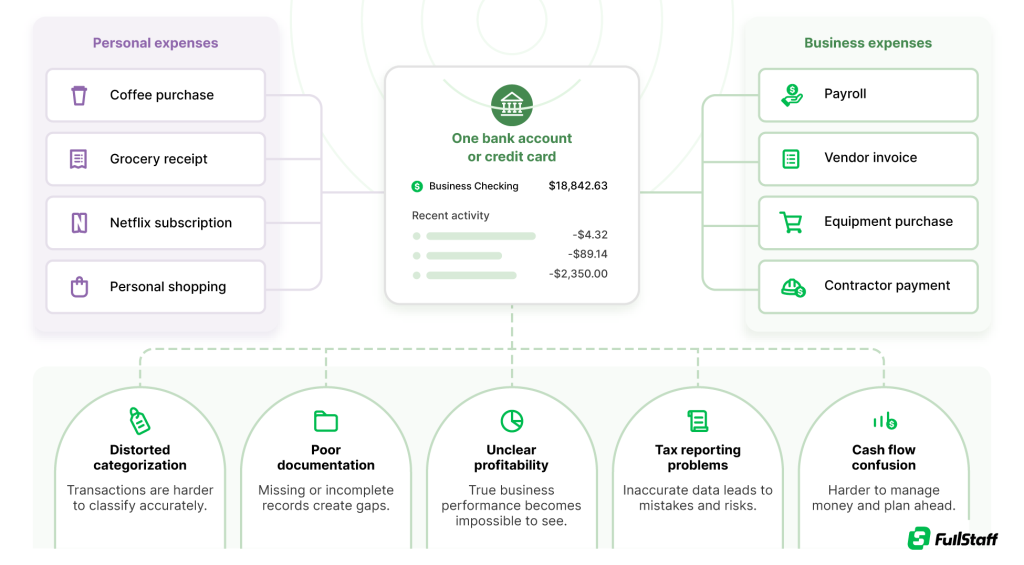
📊 According to Ramp’s 2026 analysis, mixing personal and business finances is the #1 small business accounting mistake because it distorts categorization, documentation, profitability, and tax reporting all at once. 3
Strong bookkeeping habits start with a clean boundary:
- Dedicated business bank accounts
- Separate business credit cards
- Consistent reimbursement processes
- Clear expense ownership
The operational consequence is simple: cleaner inputs create cleaner reporting.
2. Categorize Transactions Weekly, Not Monthly
Delayed categorization makes transactions harder to identify and temporarily hides expenses from reporting.
Waiting until month-end to categorize transactions means relying on memory for charges that are weeks old. A weekly review keeps records current, makes spending patterns easier to track, and prevents expenses from quietly disappearing from reports. It also turns categorization into a quick routine rather than a time-consuming cleanup task. Establishing consistent bookkeeping routines helps businesses maintain accurate records and improve visibility into business finances over time. 4
More importantly, delayed categorization affects business visibility. If transactions remain uncategorized, expenses can temporarily disappear from reporting. The result:
- Profit margins appear inflated
- Cash movement becomes harder to explain
- Spending trends become difficult to identify
Bookkeeping for small business works better when transaction review becomes an operational routine—not administrative catch-up.
3. Reconcile Every Month Without Exceptions
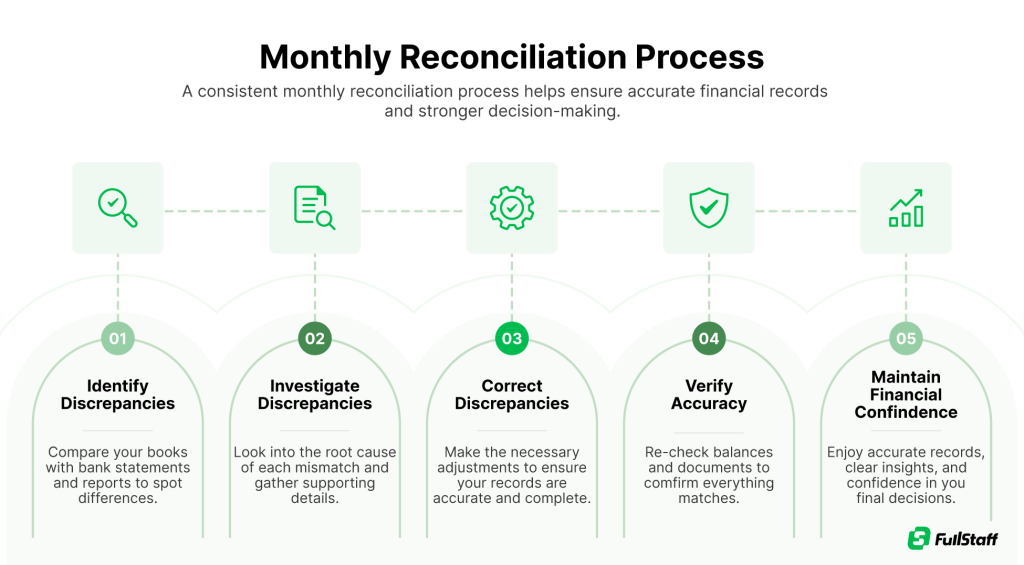
Reconciliation sounds technical. In practice, it answers a simple question: “Do the records match reality?”
Skipped reconciliations let small discrepancies compound into larger reporting problems. When bank accounts, credit cards, and bookkeeping records do not align, small discrepancies compound quickly.
📊 The Federal Reserve’s 2024 Small Business Credit Survey found that 51% of firms reported uneven cash flow as a major financial challenge — a figure directly tied to poor reconciliation and delayed financial visibility. 5
Unreconciled accounts often create duplicate expenses, missing transactions, inaccurate balances, reporting delays or cash flow confusion.
According to guidance from accounting organizations such as AICPA, regular reconciliation is one of the core controls that supports reporting accuracy and financial confidence.

4. Close Books on a Fixed Monthly Schedule
Businesses often say: “We’ll close once things slow down.” Things rarely slow down. A structured close process creates reporting discipline.
That process usually includes:
- account reconciliation
- invoice review
- expense verification
- payroll checks
- reporting updates
Without a fixed close schedule, financial reporting gradually shifts from operational visibility into historical recordkeeping. Most businesses target the first week after month-end. The specific date matters less than sticking to it.
5. Capture Documentation in the Moment
Missing documentation creates audit risks, uncategorized spending, and reporting delays.
Receipts and invoices are easy to file immediately and easy to lose if left for later. Businesses with organized records typically build simple capture habits — a scanning app, a shared cloud folder, or an email forwarding workflow. The goal is not a perfect filing system. It is making documentation retrieval fast and reliable when it is needed. IRS guidance recommends maintaining organized business records because documentation directly affects deductions, tax reporting, and audit readiness. 6
6. Review Reports Monthly—Not Just During Tax Season
A monthly report review does more than confirm what was spent. It surfaces early indicators — margins narrowing, expenses outpacing revenue, cash tightening — before they become problems that require urgent attention. Owners who review reports regularly tend to make faster, better-informed decisions than those who only look at the numbers during tax season. The SBA notes that consistent financial review supports stronger cash visibility and more informed business planning. 7
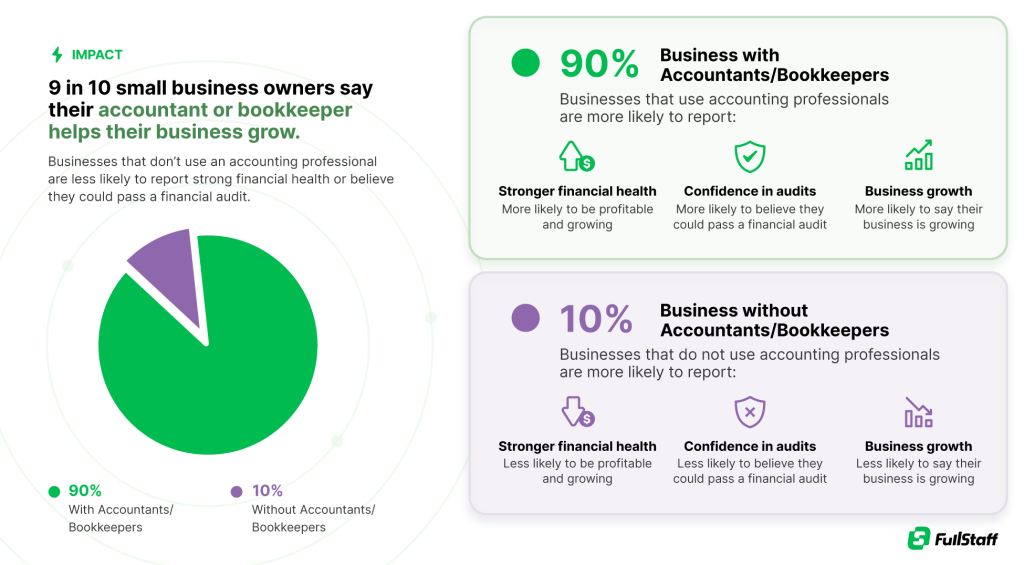
📊 9 in 10 small business owners say their accountant or bookkeeper helps their business grow. Businesses that don’t use an accounting professional are less likely to report strong financial health or believe they could pass a financial audit. 8
It can uncover questions such as:
- Are margins shrinking?
- Are expenses increasing faster than revenue?
- Are payroll costs changing?
- Is cash becoming tighter?
- Which categories are becoming unusually expensive?
This aligns with FullStaff’s evolving philosophy: businesses do not ultimately want bookkeeping. They want clarity, confidence, and help translating numbers into business decisions.
AI increasingly helps automate categorization and repetitive finance workflows. Human expertise increasingly creates value through analysis and interpretation.
Understanding what the P&L is telling you is more valuable.
7. Bring in Support Before Cleanup Becomes a Project
Bookkeeping bottlenecks appear during growth, and the strongest systems are proactive rather than reactive.
Most businesses wait too long to ask for bookkeeping help. By the time the backlog feels unmanageable, it usually is. Growth adds transaction volume, vendors, payroll complexity, and reporting requirements faster than internal processes tend to keep up. Bringing in support early — before the books fall behind — is significantly less disruptive and less expensive than catching up after the fact.

📊 Cash flow problems are cited as a contributing cause of small business failure 82% of the time. 9 Clean, current books are one of the most reliable defenses against that outcome.
📊 According to LendingTree’s 2026 data, 22.1% of new U.S. businesses fail within their first year, and 48.6% close within five years. 10 Proactive financial management significantly reduces those odds.
Frequently Asked Questions (FAQs)
How much time should bookkeeping actually take each month?
For most small businesses, a weekly transaction review takes 30 to 60 minutes. Monthly reconciliation and report review add another two to three hours. The total is manageable when bookkeeping for small business is treated as a routine, not something saved for the end of the month.
What is the difference between bookkeeping and accounting?
Bookkeeping is the process of recording and organizing financial transactions on an ongoing basis. Accounting uses that data to analyze performance, file taxes, and support financial decisions. Clean bookkeeping makes accounting faster and more accurate.
When does a small business need a professional bookkeeper?
A good rule of thumb is before the backlog becomes unmanageable. If reconciliations are being skipped, reports are regularly delayed, or tax season feels like a cleanup project, those are signs that the current small business bookkeeping system is not keeping up with the business.
Does bookkeeping software replace a bookkeeper?
Software handles data entry, categorization, and report generation more efficiently than manual methods. But it still requires someone to review the output, catch errors, and interpret what the numbers mean for the business. Software and professional oversight work better together than either does alone
How do mixed personal and business expenses affect a small business?
They distort profitability reporting, complicate tax preparation, and make it harder to understand where money is actually going. Separating the two from the start is one of the simplest ways to keep small business books accurate.
What causes most small business bookkeeping backlogs?
Growth. More transactions, more vendors, more payroll activity, and more reporting requirements arrive faster than internal processes evolve. Most backlogs are not caused by carelessness. They are caused by systems that were not designed to scale.
What bookkeeping mistakes hurt small businesses most?
Delayed reconciliations, mixed personal spending, inconsistent categorization, and irregular reporting schedules create the most common issues. Most problems with bookkeeping for small business start as small workflow gaps before becoming larger reporting problems.
Can AI replace bookkeepers?
AI can automate repetitive tasks such as categorization, invoice processing, and reconciliation workflows. Small businesses still rely on experienced professionals for oversight, financial interpretation, compliance review, and decision support.
How often should small business bookkeeping be reviewed?
Weekly transaction review and monthly financial reporting are common operating rhythms. Consistency matters more than complexity.
Why do small businesses fall behind on bookkeeping?
Growth often increases transaction volume faster than internal processes evolve. Reporting delays usually reflect operational bottlenecks, not lack of effort.

Let FullStaff Handle Your Bookkeeping
Keeping up with consistent bookkeeping becomes harder as your business grows. More transactions, more accounts, and more moving parts often leave financial tasks pushed to the side. FullStaff helps businesses stay organized with dedicated bookkeeping support built around clean reporting and reliable processes.
Since 2012, FullStaff has provided US-based businesses with bookkeeping professionals trained in US GAAP standards. Your dedicated team can handle:
- Bank and credit card reconciliation
- Transaction categorization and coding
- Accounts payable and receivable tracking
- Monthly close and reporting
- Profit and Loss statements
- Business reporting and insights
- Catch-up bookkeeping support
Here’s how it works: complete a short kickoff form, meet with the team to discuss your needs, and get matched with a dedicated accounting professional who helps organize your workflows from day one.
👉 Get started with FullStaff today and gain cleaner books, faster reporting, and better visibility into your business performance. Plans start at $200/month and scale alongside your business needs.
References:
- The Hidden Cost of DIY Accounting: Why Entrepreneurs Should Focus on Growth, Not Spreadsheets
- 8 Most Common Accounting Mistakes Small Businesses Make
- 6 small business accounting mistakes to avoid
- Bookkeeping 101: Bookkeeping Basics for Small Businesses
- 2025 Report on Employer Firms: Findings from the 2024 Small Business Credit Survey
- What kind of records should I keep
- SBA-Manage your finances
- 20 small business financial literacy statistics to know
- The #1 Reason Small Businesses Fail – And How to Avoid It
- LendingTree / U.S. Bureau of Labor Statistics